


Contemporary mystery fiction is gradually shifting away from being purely “puzzle games” toward a broader reading experience. It is no longer defined solely by the construction of intricate tricks; character and atmosphere have become equally important, and in some cases, humor and emotional tone themselves take center stage in the narrative. The novels recommended below use a light mystery or crime framework as a foundation, while offering a reading experience that is lively, immersive, and deeply entertaining.
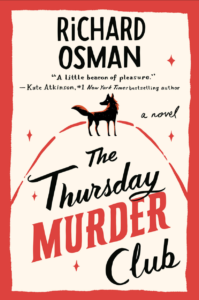
The Thursday Murder Club by Richard Osman
Source: Amazon Australia
https://www.amazon.com.au/Thursday-Murder-Club-Richard-Osman/dp/1984880969
In a quiet retirement community in England, a group of elderly residents with very different personalities meets weekly to discuss unsolved historical cases. On the surface, it appears to be little more than a hobby club with a touch of pastime curiosity, but when new real-life crimes begin to occur, they gradually find themselves drawn into active investigations.
What makes the novel most compelling is not the complexity of its cases, but its character work. Each protagonist is vividly drawn, with distinct backgrounds and temperaments: some are sharp and outgoing, others calm and restrained, while a few carry the habits and emotional scars left behind by their former professions. By placing such contrasting personalities in the same space, the author turns dialogue into the main driving force of the narrative. Humor runs throughout the book as a key element. Many scenes unfold in a light, occasionally tongue-in-cheek tone, ensuring that the subject of “murder” never feels oppressive or overly grim. Ultimately, the novel’s appeal lies less in intricate plotting and more in the interplay between its characters.
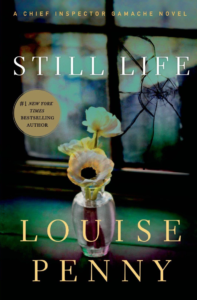
Still Life by Louise Penny
Source: Amazon
https://www.amazon.com/Still-Life-Chief-Inspector-Gamache/dp/1427258333
Still Life, the first book in the “Three Pines” series, is set in a quiet village in Quebec, Canada. The residents here all know one another, life moves at a slow pace, and there is an almost self-contained sense of calm. However, a sudden death disrupts this fragile equilibrium, and the investigating inspector, Gamache, is drawn into a community that appears peaceful on the surface but is quietly filled with undercurrents.
The novel’s core is not built around fast-paced puzzle solving, but rather on the gradual layering of atmosphere and emotion. The residents of the village form a stable, finely textured social fabric, and when the crime occurs, the secrets and emotions of each individual slowly begin to surface. Its investigative rhythm is unhurried, yet the atmosphere is fully realized, and the psychological portrayal of its characters is handled with great care. As a result, the reader feels less like they are following a chain of criminal logic, and more like they are gradually coming to know an entire community.
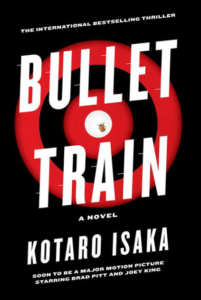
Bullet Train by Kotaro Isaka
Source: Amazon
https://www.amazon.com.au/Bullet-Train-Kotaro-Isaka/dp/1419756338
Bullet Train is set aboard a high-speed train, where each character has their own mission, objective, and hidden motives. As the train continues its journey, the characters’ paths gradually intersect, and actions that initially seem independent begin to influence one another, setting off a larger chain reaction.
The novel moves at a brisk pace, with constantly shifting perspectives that give the reading experience a distinctly cinematic feel. Unlike traditional mystery fiction, it does not rely on tightly constructed logical deduction, but instead relies less on strict logical deduction and more on momentum, coincidence, and the unpredictable consequences of each character’s actions. At the same time, the novel is marked by a strong sense of dark humor. Tension and absurdity coexist throughout, preventing the violence and moments of crisis from feeling uniformly heavy. Instead, they are rendered with a kind of rhythmic, almost playful sense of entertainment.
Featured Image Source: The Hollywood Reporter
https://www.hollywoodreporter.com/movies/movie-reviews/the-thursday-murder-club-review-helen-mirren-netflix-1236347291/
Leave a Reply